
GPU nodes
High-performance resources for training LLMs, GANs, and DRL models used in resource allocation, IoT caching, hyperspectral image processing, and medical-information analysis.
Project details
The primary goal of this project is to acquire and commission a new 16-GPU cluster to support AI, hyperspectral imaging, and optics research at the University of Puerto Rico at Mayagüez. The GPUs will work together to enable training and inference with deep-learning models used in reinforcement learning, multispectral image processing, large language models, text summarization, and prediction of data items to be accessed from a cache. The cluster will interface with existing computing clusters and Science DMZ infrastructure to enable new use-inspired AI research in analytics, remote sensing, computational optics, climate change, wearable technologies, and IoT data caching.
Background
Computational tools are central to today’s science and engineering research. These tools span large computer clusters, hardware accelerators for AI inference, high-resolution imaging devices, large-scale storage, Big Data analytics systems, scalable AI frameworks, and complex simulation tools. Researchers use them to collect, store, and analyze heterogeneous collections of row data, columnar data, images, video, text, and simulation results. As datasets grow in size and complexity, sophisticated analysis continues to push AI frameworks and data-processing systems to their performance and scalability limits.
The challenge
Meaningful AI research requires access to hardware accelerators such as GPUs, TPUs, and FPGAs. The model sizes and training demands associated with Generative AI, LLMs, GANs, and DRL make CPU-only systems impractical. Cloud platforms are useful for instruction and prototyping, but limited third-party library support, unpredictable usage fees, network latency, and session timeouts can make daily work with complex models challenging.
Scientists also need large volumes of suitable training data. Storage and computation are increasingly separated, while cameras, sensors, and robots generate high-resolution data at accelerating rates. Data-streaming systems must fuse, filter, and analyze these streams quickly; effective edge devices also require onboard processing and high-speed network connections.
Campus-wide vision
The broader vision connects computing and sensing resources to support seamless image acquisition, data fusion, and analytics. This award focuses on the GPU-node component.
High-performance resources for training LLMs, GANs, and DRL models used in resource allocation, IoT caching, hyperspectral image processing, and medical-information analysis.
Resources for implementing pre-trained models and running real-time inference for IoT data caching, onboard prototypes, and drone-mounted cameras.
Networked imaging instruments mounted on drones for coastal image collection and monitoring nearshore habitats.
Platforms that transport cameras and other sensors to enable integrated hyperspectral image acquisition, processing, and analysis.
Focus of this project: This award focuses on the first component of the broader AI-HSI vision: acquiring and commissioning the 16-GPU cluster. The cluster will interface with UPRM’s existing computing clusters and Science DMZ infrastructure. The project team is pursuing additional support for the other components of the envisioned campus-wide cyberinfrastructure.
Project goals
The award combines instrument deployment with training and reusable learning resources.
Research program
Each thrust applies the shared computing instrument to a distinct family of research questions.
Thrust 1
Lead Manuel Rodriguez-Martinez
Build data-analytics engines enhanced with AI and hardware accelerators for custom analysis and predictions.
Thrust 2
Lead Emmanuel Arzuaga-Cruz
Develop an integrated machine-learning-based, multi-sensor analysis framework that uses the temporal, spatial, and spectral diversity of current satellite imagery.
Thrust 3
Lead Heidy Sierra-Gil
Develop AI methods and computational optical imaging for a platform that obtains microscopy images for medical applications.
Facilities and infrastructure
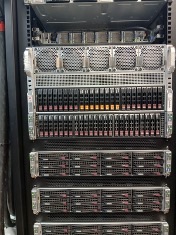
The planned instrument comprises 2 Lambda Scalar 4U AMD servers. Each server is equipped with 8 NVIDIA H200 GPU cards, 2 TB of RAM, and 5 TB of storage. Each GPU provides 141 GB HBM3e memory. The cluster will integrate with UPRM SciNet, the Voyager cluster, PetaStore storage, and existing Science DMZ infrastructure.
Education and workforce development
The instrument will support research carried out by graduate and undergraduate students. Students will receive training in LLMs, DRL, GANs, data fusion, remote sensing, and hyperspectral image processing. They will serve as AI ambassadors who can help expand AI literacy beyond computing into marine sciences, agricultural engineering, public health, engineering, and the physical sciences. The development of applied AI tools can also bring students from other disciplines into the work as users and future researchers.
Broader impacts
The project will broaden participation in AI-enabled, use-inspired research involving climate change, remote sensing, medical informatics, IoT, and analytics. It will create opportunities for collaboration across disciplines, support graduate theses and scientific publications, and engage undergraduate researchers. As a Hispanic-serving institution in the Puerto Rico EPSCoR jurisdiction, UPRM is positioned to prepare more students for advanced study and the AI workforce while strengthening research capacity in an underserved jurisdiction.
| Period | Milestone |
|---|---|
| Year 1 | Instrument acquisition |
| Year 2 | Deployment, configuration, and testing |
| Year 3 | Training and research use |