GPU node acquisition
Acquire two Lambda Scalar 4U AMD servers, each equipped with 8 NVIDIA H200 GPU cards, 2 TB of RAM, and 5 TB of storage; integrate the cluster into UPRM SciNet; and operate it with the Voyager cluster and PetaStore storage.
NSF Award OAC-2407329
The primary goal of this project is to acquire and commission into operation a new 16-GPU cluster to enable AI, hyperspectral imaging, and optics research at the University of Puerto Rico, Mayagüez (UPRM).
Project overview
This project aims to enhance research capabilities in artificial intelligence, hyperspectral imaging, and optics at the University of Puerto Rico at Mayagüez through the acquisition and commissioning of a high-end GPU cluster. The cluster will help UPRM compete in use-inspired AI projects involving climate-change research, remote sensing, natural-language processing for medical informatics, the Internet of Things, and data analytics. Research will be complemented by training activities that strengthen innovation, workforce development, and research collaboration.
Meaningful research in AI, whether foundational or use-inspired, requires access to hardware accelerators such as GPUs, TPUs, and FPGAs. This is particularly true for Generative AI, Large Language Models (LLMs), Generative Adversarial Networks (GANs), and Deep Reinforcement Learning (DRL), where model size and training demands make CPU-only systems impractical.
Edge devices such as cameras, sensors, and robots are also automating image-data acquisition at vast rates. Keeping pace requires data-streaming systems that can fuse and filter data, apply machine-learning operations, and deliver results to visualization dashboards with minimal delay.
Major objectives
The project pairs acquisition and integration with hands-on training and shared resources for the UPRM research community.
Acquire two Lambda Scalar 4U AMD servers, each equipped with 8 NVIDIA H200 GPU cards, 2 TB of RAM, and 5 TB of storage; integrate the cluster into UPRM SciNet; and operate it with the Voyager cluster and PetaStore storage.
Train graduate students, faculty, and postdoctoral researchers to use the cluster with machine-learning software, pre-trained model hubs, LLMs, GANs, and DRL.
Provide a platform and hub for AI resources that helps researchers at UPRM and across Puerto Rico use AI effectively in their research projects.
Research areas
The new infrastructure supports data-intensive work across analytics, sensing, and computational imaging.
Build data-analytics engines enhanced with AI and hardware accelerators for custom analysis and predictions.
Develop a machine-learning-based, multi-sensor analysis framework that uses the temporal, spatial, and spectral diversity of current satellite imagery.
Develop AI methods and computational optical imaging for a platform that obtains microscopy images for medical applications.
Connected infrastructure
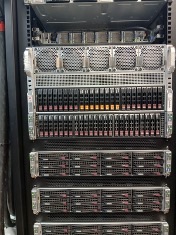
The GPU cluster will integrate with UPRM SciNet, the Voyager cluster, PetaStore storage, and Science DMZ infrastructure.
Project leadership
The investigators bring expertise in AI, analytics, remote sensing, and computational optical imaging.

Principal Investigator and Project Director
Professor of Computer Science and Engineering
Email Manuel
Co-Principal Investigator
Professor of Computer Science and Engineering
Email Emmanuel
Co-Principal Investigator
Professor of Computer Science and Engineering
Email HeidySupported by the National Science Foundation